

Hey there, if you've ever shopped for electrical cables for home wiring, appliance connections, or small industrial setups, you've probably stumbled on 2core RVV Cable-super common, flexible, and straightforward, right? But a question I get ALL the time from both DIYers and electricians is, "Is this stuff actually flame-retardant?" And as someone who's been supplying these cables for over a decade, I don't blame folks for asking. Fire safety with electrical components is no joke-even a tiny flaw here can lead to big problems, so it's totally fair to dig into the details.
First, let's break down what 2core RVV Cable even is, in case you're not deep in the cable specs. RVV stands for Rubber Vinyl Sheathed, basically a flexible cable with two (or more) stranded copper cores, wrapped in a plastic insulation and a outer sheath. The "2core" part means it has two conductors-usually a live and a neutral, no ground wire (that's important to note, but more on that later). As a supplier, I point people to our product page for the exact specs: check out our official 2core RVV Cable link if you want to see the full material lists and test data, because that's where all the hard numbers live.
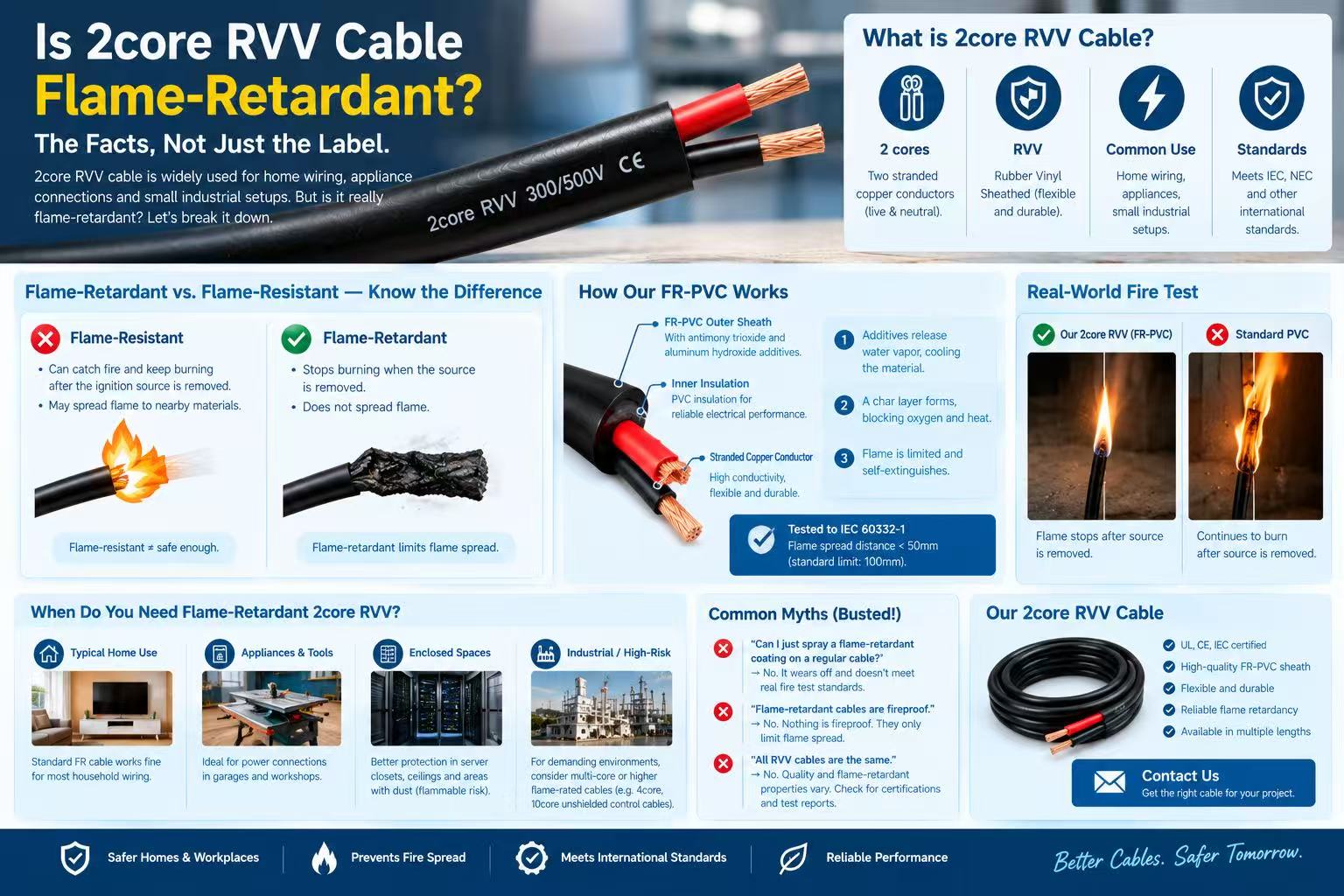
Now, the flame-retardant part-let's get real: not all 2core RVV Cable is made equal. You'll see two main types on the market, even within the same product line. The cheaper, entry-level stuff often uses basic PVC (polyvinyl chloride) for the outer sheath. Standard PVC is a flame-resistant material, wait-hold on, don't mix up "flame-resistant" with "flame-retardant." There's a subtle but huge difference here. Flame-resistant means something can catch fire and keep burning on its own once the ignition source is removed. Flame-retardant means it stops burning when the source is taken away, and it doesn't spread the flame to nearby materials. That's a key distinction most people miss.
Our standard 2core RVV Cable, for example, uses a special flame-retardant PVC (FR-PVC) for the outer sheath. Why? Because FR-PVC has additives-like antimony trioxide and aluminum hydroxide-that act as a fire barrier. When exposed to a small flame, those additives release water vapor that cools the material, and they form a char layer on the surface that blocks oxygen and keeps heat from reaching the inner cores. We test every batch we ship: we follow IEC 60332-1 standards, which is the global go-to for single-wire flame propagation tests. That test measures how far a flame travels along the cable after 45 seconds of ignition. For our 2core RVV, that distance is under 50mm-way below the 100mm limit for flame-retardant cables. No, it won't just burn forever if a small spark hits it; it self-extinguishes.
But wait, what about lower-quality 2core RVV Cable? Some cut corners-they use cheap, unmodified PVC that doesn't have those flame-retardant additives. That stuff will keep burning once the flame source is removed. I've seen it happen: a buddy who does residential rewiring picked up a bulk order from a no-name supplier, and when he tested it, the outer sheath didn't stop burning. It's not that it's dangerous in every single use-for short runs inside a wall cavity with good ventilation, maybe-but if you're using it near heat sources (like space heaters) or in enclosed spaces, that's a risk. So when you're comparing products, don't just look at price; check if they mention compliance with IEC or NEC standards, and ask for test reports.
Now, let's talk use cases, because that ties directly to whether you need a flame-retardant 2core RVV. For example, if you're running power to a table saw in a garage, or a TV inside a finished wall, a standard flame-retardant 2core RVV works fine. But if you're using it in a crowded server closet, or along a ceiling where dust can accumulate (dust is flammable!), you might want something even more robust. Wait, but our 2core is for general use-if you need more cores or a different build, we also have Unshielded Control Cable lines that include mult-core options, and even specific ones like the 4core RVV Cable or 10core Flexible Cable for Equipment which might have higher flame ratings for industrial jobs. That's the cool thing about unshielded control cables-you can match the core count and flame properties to your exact space.
A common question I get: "Can I just add a flame-retardant spray to a regular 2core RVV?" Let me save you the trouble-don't do that. Those sprays wear off over time, especially if the cable is flexed (which RVV cables do a lot), or exposed to dust or moisture. They don't bond to the PVC properly, so they won't pass a real fire test. The only way to get consistent flame retardancy is from the factory, where those additives are mixed into the sheath material during extrusion- that's how it's permanent, not a surface coat.
Another myth I hear: "Flame-retardant cables are fireproof." Nope, that's impossible. Nothing is truly fireproof-even ceramic cables will break down in a hot enough fire. Flame-retardant just means it limits flame spread, which is exactly what you want in most residential and commercial setups. For example, if a faulty appliance starts a small fire, a flame-retardant 2core RVV will stop that fire from jumping to the nearby drywall or other wiring-buying you time to put it out before it spreads. That's the real value here.
Let's talk about copper cores, too-because they're part of the cable's performance too. RVV cables use stranded bare copper, right? For our 2core RVV, the copper is annealed, which makes it more flexible-perfect for tight bends or moving appliances. The insulation around the cores is also PVC, usually with its own flame-retardant additives, so even if the outer sheath is compromised, the inner cores are less likely to ignite. That's a double layer of protection you don't get with cheaper cables that skip the core insulation.
I should also mention what 2core RVV isn't. It doesn't have a ground conductor-so if you're wiring something like a washing machine, you need a separate ground wire, which is why people often ask about multicore cables. Our Multicore Flexible Cable lines can have 3 or more cores, including a ground, so that's a better fit for appliances that need that safety feature. But for things like lamps, power cords for small electronics, or low-load wall outlets, 2core is totally fine, as long as it's flame-retardant.
Now, let's get into how to spot a good flame-retardant 2core RVV Cable vs. a dud. First, check the packaging or product label. It should say something like "flame-retardant per IEC 60332-1" or "compliant with NEC 725" (for US markets). If it just says "flexible cable" or "electrical wire" without any flame rating, walk away. Second, feel the outer sheath-flame-retardant FR-PVC is a bit thicker and more rigid than standard PVC, but not too much. If it's super flimsy and cracks easily when you bend it, that's probably the cheap stuff. Third, ask your supplier for a COC (Certificate of Compliance) or a test report. A legitimate supplier (that's us, of course) will have no problem sharing that-if they hesitate or can't provide it, that's a red flag.
We've had customers tell us they tried the no-name 2core RVV, and when they did a small test (like holding a lighter to it for 10 seconds), it kept burning after the lighter was removed. That's exactly the risk we're talking about. I've had a few jobs where a contractor switched to our flame-retardant 2core because a previous cable failed a fire safety inspection, and they saved themselves from rework and fines. Safety isn't something to cut corners on, especially with electrical components.
What about outdoor use? Wait, hold on-2core RVV Cable is mostly for indoor use, right? The outer sheath isn't UV-resistant, so if you run it outside, the sun will break down the PVC and it'll become brittle over time. If you need a cable for outdoor use, we have other lines, but that's a separate topic. For indoor residential, office, or light industrial setups, the flame-retardant 2core is exactly what you need-again, confirm the rating on the label.
Another thing: some people confuse RVV with VV cable. VV is vinyl-insulated, vinyl-sheathed, but usually with rigid copper cores, not stranded. RVV is stranded, so it's more flexible, which makes it way easier to work with, especially for tight spaces. And when it's flame-retardant, that flexibility doesn't come at the cost of safety-we design our 2core RVV to be both easy to install and fire-safe, so you don't have to choose.
Let's wrap this up: to answer the original question, "Is 2core RVV Cable flame-retardant?" The answer is-sometimes, but not always. It depends on the materials the manufacturer uses. If it's a quality product with FR-PVC in the outer sheath, tested to IEC 60332-1 or similar standards, then yes, it is flame-retardant. It won't catch fire and keep burning once the ignition source is removed, which is the key standard for residential and commercial safety. But if it's a cheap, unmodified PVC cable, then no-it's not flame-retardant, and that's a safety risk.
If you're in the market for a reliable flame-retardant 2core RVV Cable, don't just go for the cheapest option. Check the specs, ask for test data, and work with a supplier who stands behind their products. We've been supplying these cables for years, and we're confident in our flame-retardant 2core RVV-we ship them to electricians, contractors, and DIYers all over, and we've never had a safety issue related to the sheath material. Whether you need 2core for a lamp, 4core for a small appliance, or a larger multicore setup, we've got options for you, too.
If you're ready to discuss your needs, or have more questions about flame-retardant properties, core counts, or installation best practices, reach out to our team to chat. We're here to help you pick the right cable for your project, no fancy jargon, just straight answers.
References:
- International Electrotechnical Commission (IEC). (2019). IEC 60332-1: Test on fire behaviour of electric cables and optical fibres - Part 1: Test for vertical flame propagation for a single insulated wire or cable.
- National Electrical Manufacturers Association (NEMA). (2021). Standards for Electrical Cables and Wires, including requirements for flame-retardant materials.
- Underwriters Laboratories (UL). (2022). UL 1581: Standard for Electrical Wires, Cables, and Flexible Cords, Section 1080 for Flame Propagation Tests.